Summer travel is having a moment. AAA projects 72.2 million Americans will travel during the Fourth of July holiday period alone, continuing a streak of record-breaking summers. But the headline number obscures something important: consumers aren’t all headed to the same place, for the same reasons, through the same decisions.
Where people live shapes how they travel. It shapes what they’re drawn to, what triggers a booking, and what kind of experience feels worth the money.
The data makes that clear. According to MRI-Simmons (Base: All U.S. Adults, Q2 2026):
- Chicago: Consumers are 31% more likely to attend conventions such as comic, gaming, and pop culture events
- San Francisco: Consumers are 65% more likely to go on a wellness retreat
- Washington, DC: Consumers are 40% more likely to visit an international city
- Los Angeles: Consumers are 28% more likely to take a cruise.
- Dallas: Consumers are 35% more likely to attend a music festival.
- Miami: Consumers are 32% more likely to go to a spa.
Sixty-five percent is not a small number. Neither is the gap between what motivates a Miami consumer and what motivates one in Dallas. These differences show up in campaign performance.
Better data starts with better local intelligence
Knowing that San Francisco consumers skew toward wellness travel is a starting point. Reaching the right households in that market, on the right screen, at the right moment, requires data that’s built for that level of precision.
Most audience data is built for broad reach, and it does that job well. But travel is a category where geography is everything. A campaign optimized against a national audience is working with an averaged picture of consumer behavior, and averages tend to smooth out the local nuances that make messaging resonate.
Locality’s Audience Engine builds from household-level viewership data across both broadcast and streaming, matched against consumer signals specific to each market. When a travel brand targets wellness-oriented households in San Francisco, the match reflects how those consumers actually watch and behave in that market. The result is targeting grounded in local reality rather than demographic approximation.
That’s the difference between a segment that looks right and one that performs.
Understanding the local opportunity
Most audience data is designed for scale. It finds large pools of consumers with shared characteristics across broad geographies, which works fine for categories where the product is more or less the same everywhere. Travel isn’t that category. The value proposition is tied to place, and place means something different depending on where the consumer is standing.
Drive markets are the clearest example. These are the geographic areas close enough to a destination that consumers are likely to drive rather than fly, typically within a four to six hour radius, and they tend to be the highest-priority targets for regional tourism campaigns because the barrier to visitation is lower. AAA data shows that 85% of Fourth of July travelers drive to their destinations, and with domestic flights averaging around $830 a ticket this summer, regional proximity has become a genuine factor in booking decisions. A state tourism organization competing for a Chicago family’s long weekend is really competing against every drivable option within a few hours. The audience, the message, and the moment are all defined by local context.
Household-level data rooted in specific markets is what makes it possible to act on that context precisely. Not broad demographic segments, but actual viewership and audience signals tied to the DMAs where consumers live and watch. That’s what turns a data insight into a campaign that performs.
What it looks like in practice
One U.S. state tourism organization ran a campaign that put this to the test. With road trips up and air travel costs rising, states with drivable draw had a real opening to reach consumers who were actively considering options but hadn’t committed. The question was whether a locally targeted approach would outperform a broader buy.
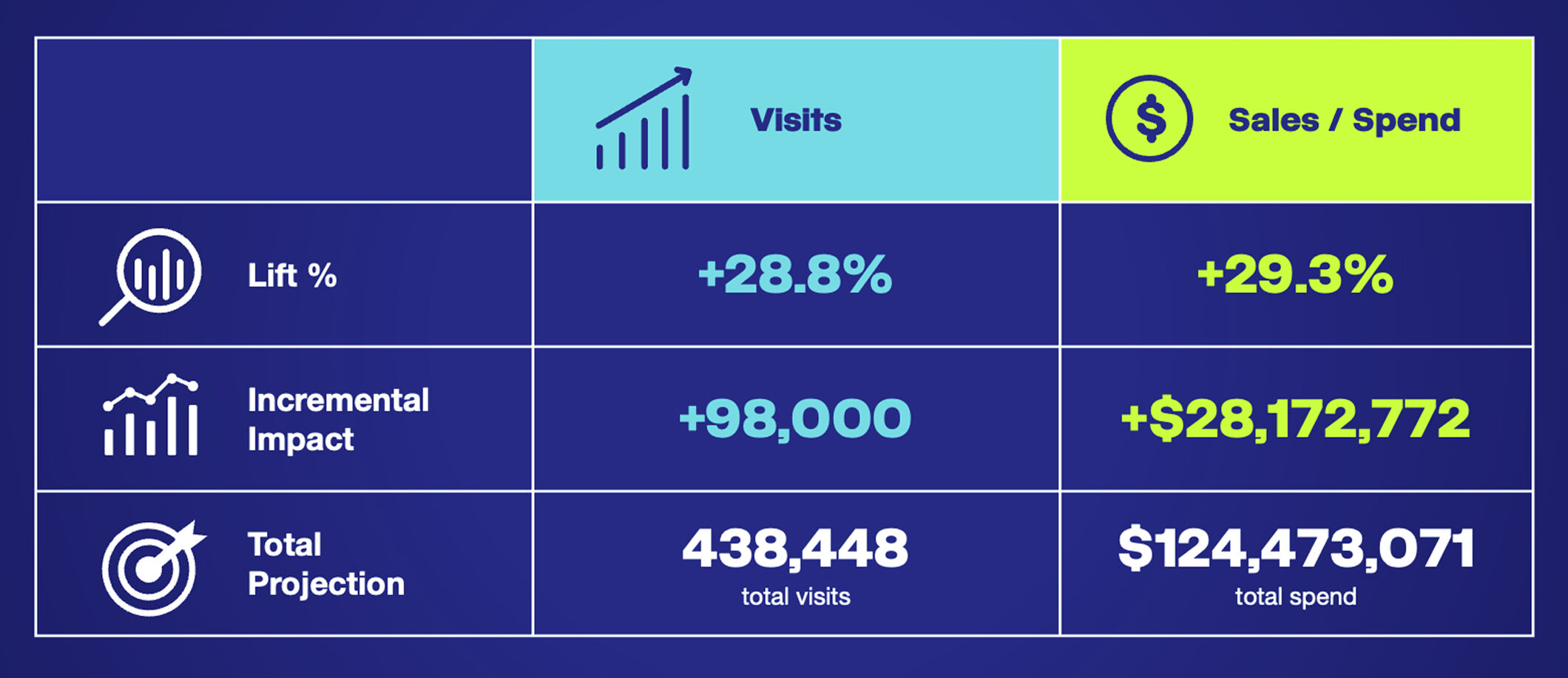
The organization partnered with Locality to plan, target, and activate a streaming TV campaign across all major publishers. Rather than a broad statewide or national buy, the campaign was built around nearby drive markets, with audience segments drawn from household-level viewership data specific to those markets. Locality handled both the planning and the execution, connecting local audience data to premium streaming inventory in a single workflow. To measure actual impact, Locality worked with Arrivalist, a destination visitation measurement firm, to track changes in visits and consumer spending among people exposed to the campaign.
The result was nearly 30% lift in both incremental visits and sales. That’s people going somewhere they might not have gone, and spending money when they got there.
Where this goes next
The broadcast and streaming landscape is more fragmented than it’s ever been. Audiences are spread across a long list of platforms, each with different inventory and different measurement. For travel brands, that could make local targeting feel harder to execute. The flip side is that when you have data that spans both broadcast and streaming at the household level, you can find your best audiences wherever they’re actually watching, across the full media environment of a given market.
That’s a different capability than what national planning tools offer. And in a category as place-specific as travel, it’s the difference between reaching the right consumer and reaching someone who looks like them on paper.
Takeaway
Consumer motivations vary significantly by market. That’s the opportunity. The brands that do well this summer won’t necessarily be the ones with the biggest budgets. They’ll be the ones that understood what mattered in each market and built accordingly.
Local isn’t just where consumers live. It’s how they travel. And it’s how the best campaigns are planned.